
Pipe Repair and Repiping for Lansing Homes
Leaking, frozen and worn-out supply and drain lines, from a single split section to a whole run of old pipe.
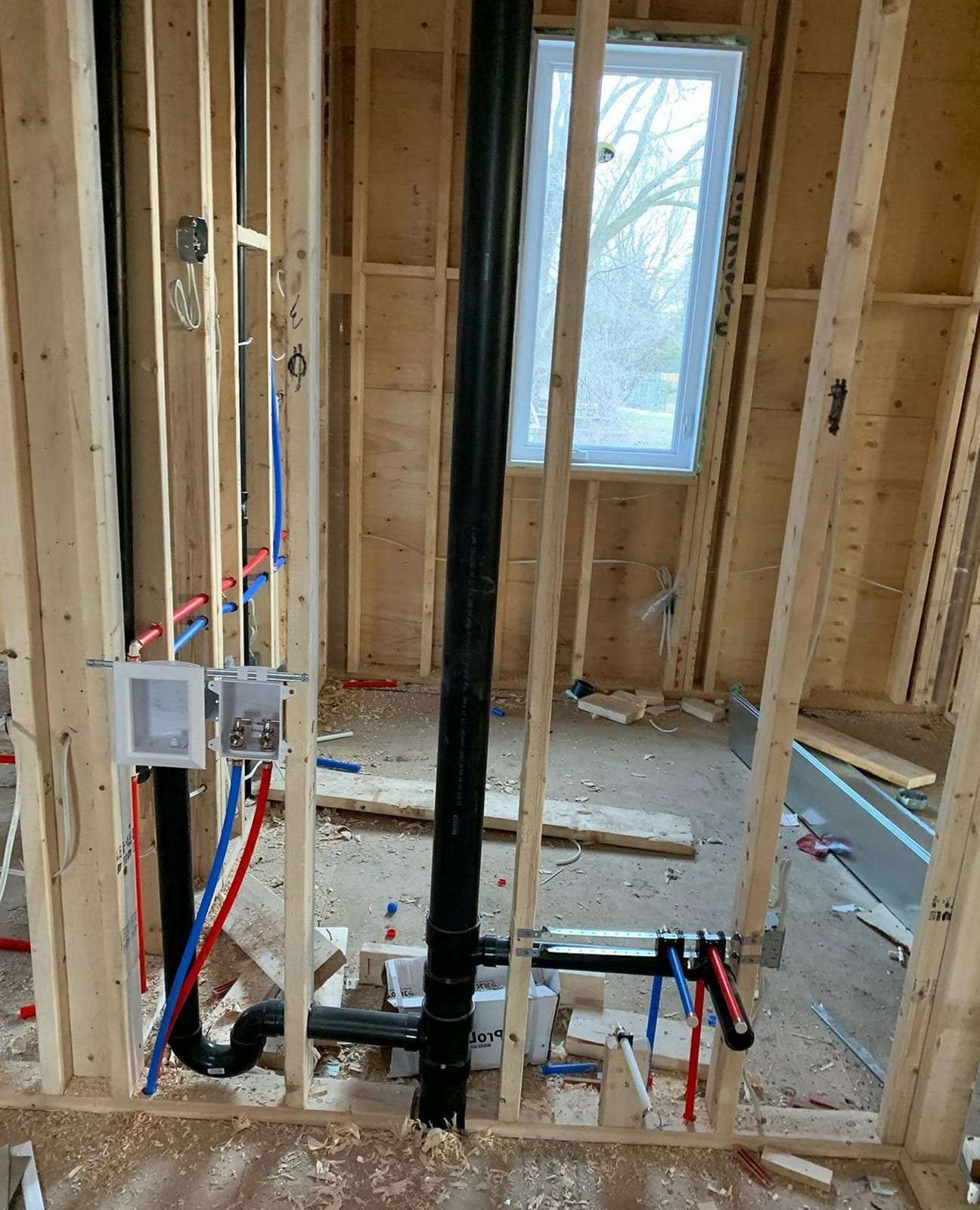
A pipe leak does not always announce itself with a drip. It can show up as a stain on a ceiling, a soft spot in a floor, a musty closet or a water meter that keeps turning. We handle leaking and frozen pipes, and we rough in new supply and drain lines for remodels, so the work ranges from cutting out one bad section to running new lines before the walls are closed.
Finding a Hidden Leak in Walls, Floors and Ceilings
Supply lines stay under pressure whether or not a tap is open, so even a pinhole keeps leaking. Look for these:
- The water meter moves with every fixture off. Close all the faucets, let the toilets finish filling, and watch the small dial or triangle on the meter that shows low flow; if it turns, water is going somewhere.
- A musty smell in a closet, a cabinet or a basement corner that does not clear.
- Warped, cupped or soft flooring, or loose tiles, near a bathroom, kitchen or laundry.
- A stained or sagging ceiling under a bathroom.
- Paint that bubbles, or drywall that feels soft along the bottom of a wall.
- A water bill that climbs while the household uses water the same way.
- The sound of running water when nothing is on.
A toilet that refills by itself moves the meter too, so check the toilets first. A few drops of food coloring in the tank that show up in the bowl without a flush mean a worn toilet flapper, not a hidden pipe leak.
Pipe Materials in Lansing Houses and Their Weak Points
What a house is plumbed with depends mostly on when it was built and what has been replaced since. Houses near downtown and in the older parts of East Lansing often still have galvanized steel supply lines and cast iron drains, while newer township subdivisions are more likely to have copper or PEX supply lines and plastic drains.

| Material | Where it is commonly found | Typical problems | Repair or replace considerations |
|---|---|---|---|
| Galvanized steel | Water supply lines in houses built before about 1960, often joined to newer pipe in places | Rust builds up inside and narrows the pipe: low pressure, brown water and leaks at threaded joints | A leak in one spot usually means others are close behind; patches buy time, and replacing the run restores pressure |
| Copper | Supply lines from the 1950s on, in older houses that were repiped and in many newer ones | Pinhole leaks, leaking joints, and splits where a line froze | A pinhole or a split is cut out and replaced; repeated pinholes along one run point to replacing that run |
| PEX | Supply lines in newer houses, remodels and repipes from about the 2000s on | Leaks at fittings, damage from rodents or sunlight, and tubing kinked during installation | A bad fitting is a quick repair, and the flexible tubing is often the choice when a whole run is replaced |
| Cast iron | Drain and vent stacks and the main building drain in houses built before about 1970 | Rust and scale inside, cracks along the bottom of level runs, and leaking joints | A cracked length can be cut out and replaced with plastic pipe and banded rubber couplings; a stack rusting through in several places is often replaced |
Repairing One Section or Repiping the Whole Line
Most leaks are fixed by replacing a short piece of pipe. Repiping makes sense when the pipe itself is failing, not just one spot on it.
Repair a Section
- Best for
- A single pinhole, a split from freezing, a leaking joint, or one cracked length of drain.
- What the work involves
- Opening the wall or ceiling at the leak, cutting out the damaged piece and joining in new pipe with fittings made for both materials.
- Watch for
- On old galvanized or badly rusted cast iron, the next weak spot may be a few feet away, and leaks tend to come back one at a time.
Repipe a Whole Line
- Best for
- Galvanized supply with low pressure everywhere, repeated pinholes along copper, or a cast iron stack failing in several places.
- What the work involves
- Running new lines from the main shutoff to the fixtures, usually in PEX or copper, through as few openings as the house allows.
- Watch for
- A larger job, with openings in walls and ceilings to patch afterward; a remodel, when the walls are already open, is a natural time for it.
Deciding Between a Patch and a Repipe in an Older House
How can I tell whether an older house needs repiping or just a repair?
Look at the pattern, not the single leak. Low pressure at every faucet, brown water after the taps sit, and leaks in more than one place on galvanized pipe point to repiping that run. One pinhole or one freeze split in copper or PEX that is otherwise sound is a repair.
Can new copper or PEX be joined to old galvanized pipe?
Yes, with the right transition fitting. Copper joined straight to steel corrodes at the joint, so a dielectric union or a brass fitting goes between them. The new pipe will last, but the joint is only as good as the old pipe threaded into it, which is why patches on galvanized tend to lead to more patches.
Does repiping mean opening every wall?
Usually not. Flexible PEX can often be fished through walls and floors from the basement and the attic, so most openings are at fixtures and where lines change direction. A finished basement ceiling or tile walls make access harder and can change the route the new lines take.
Can a house be repiped in stages?
Often, yes. A common order is the main line from the meter first, then the runs to the kitchen and the bathrooms, then the rest, so the pipe that carries the most water is replaced first. Each stage leaves a joint between new and old pipe, so staging works best when the whole job is planned at the start.
Split Pipes After a Michigan Cold Snap
A hard freeze finds the same weak spots in mid-Michigan houses: supply lines in outside walls, lines over unheated garages and through crawl spaces, and the pipe to an outdoor faucet. Ice in a line builds pressure until something gives, so copper splits along its length, fittings crack, and even PEX can pull loose at a joint. The leak often shows only after the ice thaws, sometimes days later, as a wet ceiling or a ring of water in the basement. If water is spraying, close the main shutoff and treat it as a plumbing emergency.
The repair is to cut out the split section and replace it, but a pipe that froze once tends to freeze again in the same spot unless something changes. The usual fixes are insulating the line, moving it to the warm side of the wall insulation, and replacing an old outdoor faucet with a freeze-proof type that shuts the water off inside the house.
Get a Leaking Pipe Repaired
A stain, a drip or a meter that will not stop is reason enough to book; for a pipe spraying water, call.