
Sewer Line Clearing, Inspection and Repair in Lansing
Main sewer lines in Lansing homes, rentals and small shops: clearing a backup, finding its cause on camera, and repairing the pipe that failed.
Main sewer lines are the center of our work: most of our calls are for one that is clogged or failing. Many older Lansing houses have maples and oaks close to the street, and over the years their roots find their way into clay and cast iron pipe until a basement drain starts backing up. We clear the line with a cable or a hydro jet, then run a camera through it to see what is wrong. When clearing is not enough, we repair or replace the damaged section.
Signs the Backup Is in the Main Sewer Line
A clog in one sink or tub stays at that fixture, and ordinary drain cleaning takes care of it. A main line problem shows up at the lowest drain in the house first, usually the basement floor drain, and soon affects every fixture that empties into the line.
| Warning sign | What it may indicate | Suggested action |
|---|---|---|
| Water rises in the basement floor drain when the washer empties or someone showers | A partial blockage in the main line, backing water up to the lowest opening | Hold off on laundry and showers, and have the main line cleared |
| Toilets gurgle, or several drains slow down at once | A blockage past the point where the branch drains join | Treat it as one main line problem rather than plunging each fixture |
| Backups come back a few weeks or months after clearing | Roots growing back through a joint or crack, or a sag where waste settles | Find the spot with a camera, then weigh repeat clearing against a repair |
| A sewage smell in the basement or the yard | A dried-out floor drain trap, a loose cleanout cap or a cracked pipe | Pour water into unused floor drains; if the smell stays, have the line checked |
| A soggy, sunken or extra-green strip of lawn over the line | A broken line leaking into the soil | Keep cars and heavy loads off the spot until the line is inspected |
| Neighbors on the street back up at the same time | A blockage in the public sewer main rather than in your lateral | Call the city or township that runs the sewer first |
What Makes a Sewer Job Larger or Smaller

Sewer jobs range from clearing a line through an easy-to-reach cleanout to replacing a deep, root-filled clay line under a driveway. The camera inspection places a job on that scale: it shows where the problem sits, how much of the line it covers and what shape the pipe around it is in.
Access matters too. A cleanout is a capped pipe that opens into the sewer line, usually just outside the foundation or in the front lawn, and it lets the cable, the jet and the camera straight into the main line.
Sewer Job Scope Explainer
Tick what you know about your sewer line to see how each point tends to change the size of the job. It gives no prices; the camera sets the real scope.
Tick what applies to your sewer line, then press the button.
Digging Up a Sewer Line or Repairing It in Place
When the camera shows damage that clearing cannot fix, such as a crack, a collapse, an offset joint or a sag, the pipe is repaired or replaced in one of two broad ways.
Open-Trench Repair
- How it works
- A trench is dug down to the damaged section, the bad pipe is cut out, and new pipe is joined to the sound pipe on each side. A line failing end to end is replaced the same way.
- Disruption to the yard
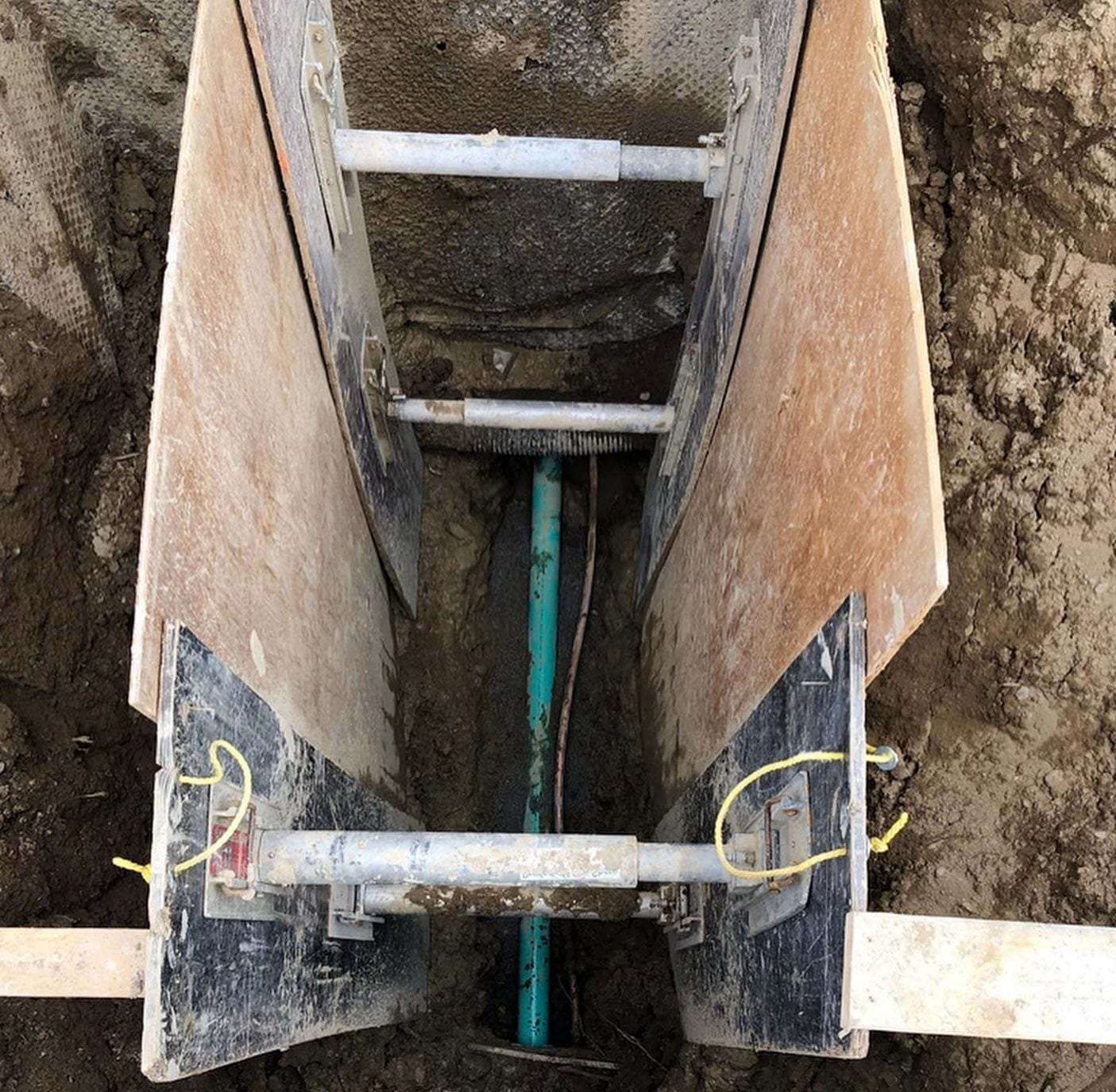
- A trench and a pile of soil along the repair; lawn, plantings or paving over it are restored afterward. A trench five feet deep or more needs shoring or a trench box while people work in it.
- Suitable situations
- Collapsed pipe, a sag that holds water, a break that is easy to reach, and any line too damaged for trenchless methods.
Trenchless Repair
- How it works
- Pipe lining pulls a resin-soaked liner into the old pipe and hardens it into a new pipe inside the old one. Pipe bursting pulls a new pipe through the old one while a cone-shaped head breaks the old pipe apart.
- Disruption to the yard
- One or two small access pits instead of a trench, so a driveway, a walk or a big tree over the line can usually stay where it is.
- Suitable situations
- A line that still holds its shape and slope: cracked pipe, root-filled joints, or a run under paving or trees. A collapsed pipe or a sag usually still means digging.
Clay and Cast Iron Laterals Under Older Lansing Houses
Many Lansing houses built before about 1960 still drain through their original lateral, the pipe that runs from the house to the public sewer main. It is usually vitrified clay, laid in short lengths with a joint every few feet, or cast iron. Clay itself holds up well, but its joints let roots in; cast iron rusts from the inside and can wear through along the bottom. Newer township subdivisions more often have plastic laterals, where a sag or a clog is the usual trouble.
Before any digging, for a sewer repair or a fence post, call MISS DIG 811, Michigan’s one-call system, a few business days ahead. The utilities then mark their buried gas, electric, water and communication lines. They do not mark private lines, so the sewer lateral itself is usually located with a camera and a locator.
Who Owns the Sewer Line Between the House and the Street
Who is responsible for the sewer lateral between the house and the street?
In general, the property owner owns the lateral from the house to the public sewer main, and the city or sewer utility owns the main. Where the split falls varies: in some places the owner’s part ends at the property line, in others it runs to the connection at the main, even under the street. The local sewer utility can tell you where yours ends.
What if the blockage is in the public main?
When several houses on a street back up at once, or a camera shows the lateral open all the way to the main, the trouble is most likely in the public sewer. That is for the city or township that runs the sewer to clear, so call them and keep water use low until then.
How can I find out where my lateral runs?
Older houses rarely come with a drawing of the lateral. The local building or sewer department may have a record of the connection, and a sewer camera head with a transmitter can be traced from above to mark the route and depth on the lawn. That is worth knowing before planting a tree over the line.
Clear the Main Line and See What Caused It
Book a visit for a slow or backed-up sewer line, or call if sewage is already coming up through a floor drain.